
Food Is Medicine: The Latest Scoop on Policy, Evidence, and How to Choose the Right Partner

Updated: Sep 23
Food Is Medicine Will Scale Through Operating Discipline, Not Just Benefit Design
Food insecurity and chronic disease rarely arrive as separate problems. A member managing diabetes may also be choosing between groceries and rent. A patient discharged from the hospital may understand the nutrition plan but lack the mobility, transportation, kitchen equipment, or household support to follow it. A pregnant member may receive a short-term benefit while the rest of the family remains food insecure.
That reality explains the growing interest in Food Is Medicine. It also exposes the central implementation challenge. Creating a benefit does not ensure that the right members receive an appropriate intervention, use it consistently, or experience outcomes that justify continued funding. Scale depends on the operating model between policy and the plate.
The intervention must match the clinical need
Food is not one uniform healthcare service. A medically tailored meal for a person with end-stage renal disease is different from a produce prescription for a member with elevated metabolic risk. Nutrition education, grocery support, pantry access, home-delivered meals, and household food assistance address different barriers.
A health plan should begin by identifying the population, the clinical objective, and the practical constraint. High-risk transitions can be especially actionable: pregnancy and postpartum periods, discharge from an inpatient stay, a new complex diagnosis, functional decline, or a period of unstable access. Targeting allows the intervention to be designed around a defined risk rather than offered as a generic food benefit.
The household matters as well. The webinar describes a food distribution effort in which intended recipients shared meals with family members, limiting the measured effect on the enrolled individual. That behavior was rational; the program design was incomplete. If a household lacks food, restricting support to one person may undermine adherence and misstate the resources required to achieve the clinical goal.
Effective programs therefore combine clinical eligibility with a realistic view of how people live. The meal, delivery model, education, language, cultural familiarity, and household allocation all contribute to whether the intervention works.
Managed care needs an accountable delivery partner
Health plans are under pressure to control utilization, improve quality, address health-related social needs, and operate within constrained margins. Food Is Medicine can support those goals, but only if the partner can translate a social intervention into a reliable healthcare operation.
That requires more than meal production. The partner must manage referrals, eligibility, outreach, delivery, dietary requirements, member service, registered-dietitian support, privacy, food safety, reporting, and escalation. It must communicate with care management teams and explain why a member did not receive, accept, or use the service.
Local organizations can bring trust and cultural relevance that national platforms struggle to replicate. The operating challenge is to preserve those strengths while meeting payer expectations for consistency, documentation, geographic coverage, and performance measurement. A credible network model needs defined standards, quality controls, data requirements, and a clear accountable entity.

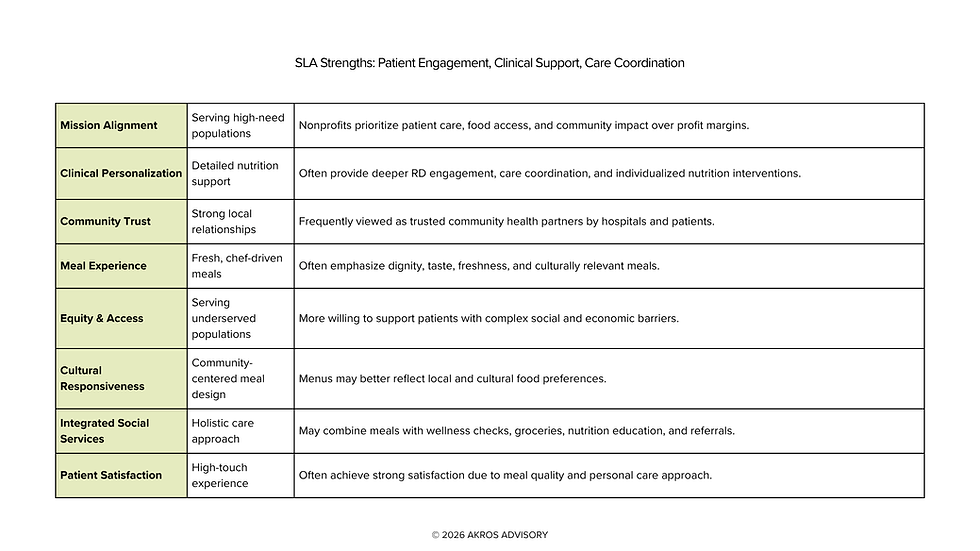
Accreditation can reduce uncertainty by establishing expectations for clinical integrity, client experience, nutrition quality, food safety, privacy, and organizational stability. It does not replace diligence, but it gives payers a more reliable starting point than evaluating every provider from scratch.
The most important data may arrive before the claim
Claims remain essential for measuring utilization and cost, but they are delayed and incomplete as an operating tool. A meal provider may know within days that a member has stopped answering the door, moved, entered the hospital, lacks refrigeration, or is sharing food with a caregiver. Those signals can help a care team intervene before a claims pattern becomes visible.
This creates value beyond fulfillment. A well-integrated provider becomes a source of timely, real-world information about member stability and barriers. To make that information usable, the plan and partner should define what will be captured, how it will be transmitted, who will act, and what privacy boundaries apply.
The data model should serve the intervention rather than overwhelm it. Delivery completion, missed deliveries, engagement with nutrition support, dietary changes, referral disposition, and member-reported barriers may be more actionable than a large dashboard of loosely related indicators. Claims and clinical outcomes can then evaluate the longer-term effect.
A credible ROI begins with a narrow causal story
Food Is Medicine programs can affect many outcomes, but an expansive list of possible benefits can weaken the business case. A payer needs to understand which members are expected to change, which utilization categories may move, and over what period.
The webinar describes an actuarial analysis that used a conservative return estimate of roughly 15 percent for a medically tailored meal program. The primary drivers were reductions in inpatient and skilled nursing facility utilization, with emergency department and transportation effects playing smaller roles. The importance of the example is not the precise percentage. It is the discipline of using a defined population, conservative assumptions, and a short list of measurable cost drivers.
That approach also recognizes that costs may rise in some categories. Better nutrition support can increase engagement with primary or preventive care. A credible model can include those increases while showing how larger avoidable costs may decline. Payers are more likely to trust a business case that reflects the full pathway than one that claims savings everywhere.
Outcome measurement should be agreed upon before launch. Baseline utilization, comparison methodology, attribution rules, data availability, eligibility duration, and the evaluation window all affect whether the result can support renewal or expansion.
Contracting should connect performance to controllable work
Value-based contracting can align a payer and provider, but the performance terms must reflect what each party controls. The plan controls eligibility rules, referral volume, data access, and often member communications. The provider controls delivery quality, outreach, service reliability, and parts of engagement. Clinical and financial outcomes depend on both, as well as on member circumstances and the broader care system.
A practical contract separates operating commitments from outcome goals. Service-level measures can address referral acceptance, delivery timeliness, dietary accuracy, response to missed contacts, and reporting. Performance measures can address engagement, adherence, utilization, or cost where the data and attribution are sufficient. Shared-risk structures should account for population size and statistical credibility.
This prevents a common failure: asking a community organization to guarantee medical savings without giving it the data, scale, or control required to produce them.
The scalable unit is a care pathway, not a meal
Food Is Medicine will not become durable managed-care infrastructure because more meals are delivered. It will scale when payers can identify an eligible member, match the intervention to the need, activate a qualified partner, monitor the experience, respond to barriers, and evaluate outcomes through a repeatable process.

The strongest partners will combine clinical discipline with human familiarity. They will deliver food that members want to eat, support dietary needs, recognize household realities, and produce evidence that finance and clinical teams can use. The strongest payers will treat those partners as part of the care model rather than a disconnected social-service vendor.
Benefit design opens the door. Operating discipline determines whether the program creates health, trust, and economic value after the door opens.
About the Speakers
Leah Hebert Welles, MBA
Chief Executive Officer at Open Arms of Minnesota
Leah has spent more than a decade leading Open Arms of Minnesota, where she oversees a multi-site, $13M+ nonprofit focused on community health and nutrition. Under her leadership, the organization has grown more than 400%, expanded innovative healthcare and government partnerships, and scaled operations to produce 1.5 million medically tailored meals each year. Connect with Leah on LinkedIn.
Demi Radeva, MSc
Founder and Chief Strategist at Akros Advisory
Demi has more than a decade of experience across Medicaid, Medicare, and Commercial health plans, including leadership roles at UnitedHealthcare and Optum. She now advises HealthTech companies on reimbursement, payer strategy, market access, and commercialization. Connect with Demi on LinkedIn.


Comments